

Treat-dispensing toys are interactive dog toys designed to release treats through chewing, problem-solving, or movement, providing both mental stimulation and a food reward in one session. The American Kennel Club classifies treat-dispensing toys as a distinct category, recommending them specifically for treat-motivated dogs who need structured mental engagement. The three core types of treat-dispensing toys are chew toys, puzzle toys, and rolling or wobbling dispensers. Each type targets a different natural dog behavior, and choosing the wrong one often leads to frustration or disinterest. This guide covers all major categories, how to match them to your dog, and which products deliver the best results in 2026.
1. What are the main types of treat-dispensing toys?
Treat-dispensing toy types include three primary categories: chew toys, puzzle toys, and rolling or wobbling toys. Each category works through a different release mechanism, and each one connects to a specific set of natural dog behaviors. Understanding the difference helps you pick the right tool instead of guessing.
- Chew and tug treat toys hold treats inside a durable body. The dog releases them by chewing, gnawing, or pawing at the toy. KONG Classic is the most recognized example. These work best for dogs who are orally fixated or need a calming, focused activity.
- Puzzle-style treat toys require the dog to complete a sequence of steps to access the treat. This might mean sliding panels, lifting cups, or spinning layers. The Outward Hound Treat Tornado is a well-known example. These toys target problem-solving instincts and are ideal for dogs who get bored quickly.
- Rolling and wobbling treat dispensers release treats as the toy moves across a surface. The dog nudges, bats, or chases the toy to earn the reward. The KONG Wobbler and the Starmark Bob-A-Lot both use this mechanism. These suit active dogs who prefer physical play over stationary tasks.
The mechanism matters because it determines how long a dog stays engaged and how much mental effort the session requires. A rolling toy gives a quick reward for light effort. A multi-step puzzle toy demands sustained focus. Matching the mechanism to your dog’s natural play style is the single most important factor in getting real use out of any treat toy.
2. Chew treat toys: what they are and when to use them
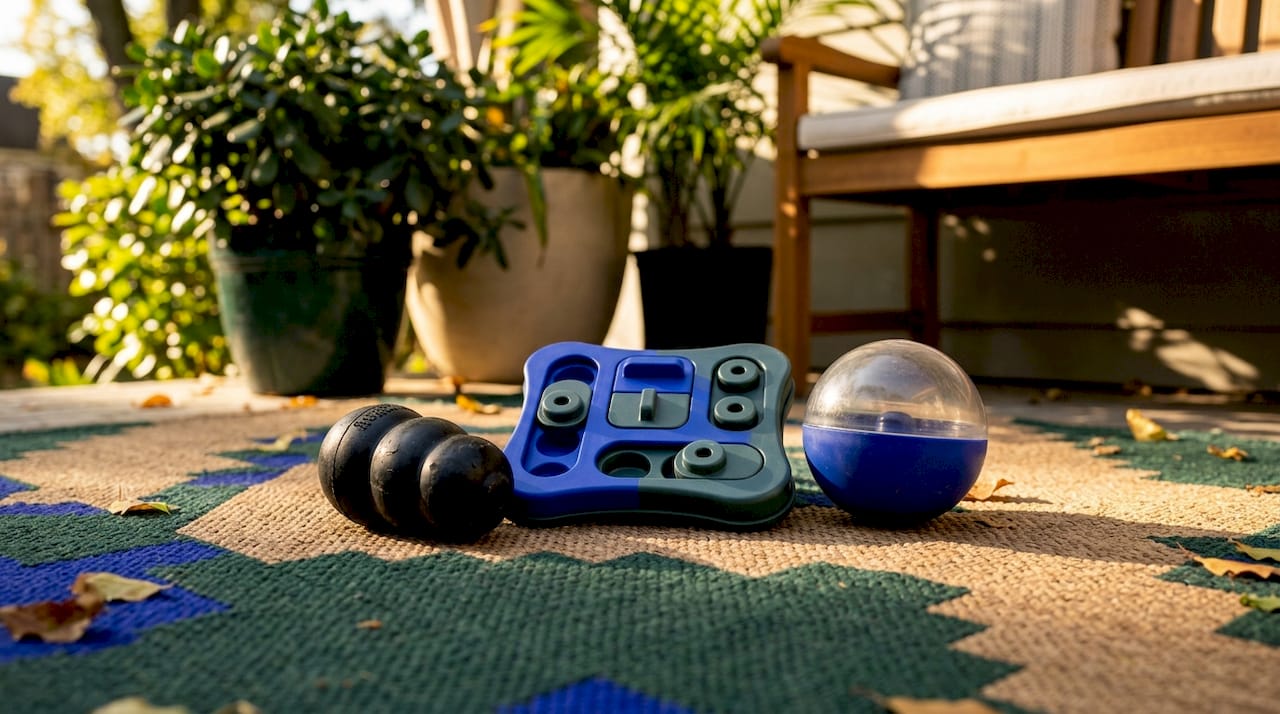
Chew treat toys are the most widely used category. They are typically made from rubber or nylon and feature a hollow center or grooved surface where treats or soft fillings can be packed. The dog works the toy with its mouth to extract the reward.
KONG Classic is the category standard. You can fill it with kibble, peanut butter, or wet food, then freeze it for a longer session. The frozen version can keep a dog occupied for 20 to 40 minutes depending on the filling and the dog’s persistence. West Paw Toppl works on the same principle but has a wider opening that makes filling and cleaning faster.
These toys serve a dual purpose. They satisfy the chewing drive, which reduces destructive behavior on furniture or shoes, and they deliver a food reward that reinforces calm, focused behavior. Enrichment toys reduce anxiety and destructive behaviors, making chew treat toys one of the most practical tools for dogs left alone during the day.
Power chewers need toys rated for aggressive chewing. Standard rubber toys can be destroyed quickly by large breeds or determined chewers, creating a choking risk. Always check the manufacturer’s size and durability rating before buying.
3. Puzzle treat toys: how they work and who they suit
Puzzle toys are the most mentally demanding category. They require the dog to manipulate parts of the toy, such as sliding trays, rotating discs, or hinged covers, to uncover hidden treats. The reward comes from solving the problem, not just from chewing.
Puzzle toys often feature adjustable difficulty to maintain challenge as the dog learns. Entry-level puzzles have one or two steps. Advanced puzzles, like the Nina Ottosson Dog Tornado or the Outward Hound Treat Tornado, require three or more sequential actions. This tiered structure matters because dogs learn fast. A puzzle that was challenging in week one may be solved in under a minute by week three.
These toys are best for dogs who show problem-solving behavior naturally. Signs include dogs who figure out how to open doors, unzip bags, or watch humans closely for cues. They are also useful for dogs recovering from injury who need mental stimulation without physical exertion.
The main limitation is supervision. Puzzle toys with small removable parts require you to watch the session. A dog that gets frustrated may chew through the toy rather than solve it, which creates a safety issue.
4. Rolling and wobbling treat dispensers: active engagement tools
Rolling dispensers are the most physically active category. The toy has a weighted base or an irregular shape that causes it to wobble or roll unpredictably when nudged. Treats fall out through a small opening as the toy moves.
The KONG Wobbler and Starmark Bob-A-Lot are the two most recognized products in this category. Both feature an adjustable opening that controls how easily treats fall out. A wider opening rewards less effort. A narrower one requires more persistent nudging, which extends the session.
The AMICUS Crazy Ball treat dispenser is another example of this rolling format, combining slow feeder mechanics with treat dispensing in a single toy. These toys work well as mealtime replacements. Instead of eating from a bowl in two minutes, the dog spends 10 to 20 minutes working for the same amount of food.
Rolling dispensers suit high-energy dogs and breeds with strong prey drive. The unpredictable movement mimics a moving target, which keeps the dog engaged longer than a stationary toy would.
5. How to choose the right treat toy for your dog
Matching the toy type to your dog’s natural behavior is the most reliable selection method. Tailoring toy choice to dog behavior patterns produces better engagement and fewer abandoned toys.
Follow this process:
- Observe your dog’s default play style. Does it chew everything, paw at objects, or chase moving things? That behavior points directly to a toy category.
- Assess current skill level. Start one difficulty level below what you think your dog can handle. Early success builds confidence and keeps the dog returning to the toy.
- Check size and material ratings. A toy rated for small dogs will not survive a 70-pound Lab. Match the toy to your dog’s weight and chewing intensity.
- Consider the use case. Chew toys work best for solo time or crate training. Puzzle toys work best for supervised sessions. Rolling dispensers work well as mealtime replacements.
- Plan for rotation. No single toy stays interesting indefinitely. Buy two or three types and rotate them weekly to maintain novelty.
Pro Tip: If your dog ignores a new treat toy, rub a high-value treat on the outside surface before the first session. The scent creates immediate interest and teaches the dog that the toy is a food source.
For guidance on toy safety and durability standards, the Ascenciongear blog covers how to choose dog toys for safety, fun, and durability in detail.
6. Comparison of popular treat-dispensing toys
The table below compares five widely used treat-dispensing toys across the features that matter most for daily use.
| Toy | Type | Difficulty | Treat compatibility | Cleaning |
|---|---|---|---|---|
| KONG Wobbler | Rolling dispenser | Low to medium | Kibble, small treats | Dishwasher safe |
| PetSafe Busy Buddy Twist 'n Treat | Rolling dispenser | Adjustable | Kibble, soft treats | Dishwasher safe |
| Outward Hound Treat Tornado | Puzzle toy | Medium | Kibble, small treats | Hand wash |
| West Paw Toppl | Chew toy | Low | Wet food, peanut butter, kibble | Dishwasher safe |
| Starmark Bob-A-Lot | Rolling dispenser | Adjustable | Kibble, small treats | Hand wash |
Popular treat-dispensing toys like the KONG Wobbler and PetSafe Twist 'n Treat dominate buyer guides because of their adjustable openings and easy cleaning. Dishwasher-safe construction is a practical advantage that owners underestimate until they are hand-washing a sticky peanut butter toy every night.
The West Paw Toppl stands apart because it connects to other Toppl units, creating a larger, more complex chew toy. This makes it one of the few products that scales in difficulty without requiring a separate purchase. For puzzle-style engagement, the Outward Hound Treat Tornado offers three rotating layers, which is enough complexity to challenge most dogs for several weeks before they master the pattern.
7. Creative and DIY treat-dispensing toy ideas
Not every effective treat toy costs money. Several low-cost and homemade options deliver real enrichment value, and rotating them alongside commercial toys keeps your dog’s routine unpredictable.
- Frozen treat toys. Frozen treat fillings like broth, plain yogurt, or peanut butter extend licking sessions significantly. Pack a KONG or any hollow rubber toy, freeze it overnight, and the session length doubles or triples compared to an unfrozen fill.
- Snuffle mats. These are fabric mats with dense loops where you hide kibble or small treats. The dog uses its nose to find the food, which activates scent-tracking instincts. Snuffle mats are one of the most calming enrichment tools available and work well for anxious dogs.
- Muffin tin puzzle. Place treats in the cups of a standard muffin tin and cover each cup with a tennis ball. The dog lifts the balls to find the treats. This is a free puzzle toy that most households can assemble in under a minute.
- Cardboard box foraging. Fill a cardboard box with crumpled paper and hide treats throughout. The dog digs and sniffs to find the reward. This works the foraging instinct and is completely free.
- Rolled towel treat toy. Lay a towel flat, place treats along one edge, and roll it up. The dog unrolls the towel to access the treats. This is a simple, supervised activity that works well for beginners.
Pro Tip: Rotate between commercial and DIY options on a weekly schedule. Dogs learn commercial toy patterns faster than you expect, and a free DIY option introduced mid-week resets their engagement without any additional cost.
For more ideas on interactive pet toys and how they support mental health, Ascenciongear’s 2026 guide covers the full category in depth.
Key takeaways
The most effective approach to treat-dispensing toys is matching the toy mechanism to your dog’s natural play style, then rotating types regularly to prevent predictability.
| Point | Details |
|---|---|
| Three core toy types | Chew toys, puzzle toys, and rolling dispensers each target a different natural dog behavior. |
| Match toy to play style | Observe whether your dog chews, paws, or chases before selecting a toy category. |
| Difficulty adjustment matters | Start below your dog’s skill level and increase difficulty as the dog masters the pattern. |
| Rotation prevents boredom | Dogs learn treat release patterns quickly, so rotating toy types sustains long-term engagement. |
| DIY options add variety | Free homemade options like snuffle mats and muffin tin puzzles deliver real enrichment value. |
What I have learned from watching dogs work through treat toys
I have watched a lot of dogs interact with treat toys, and the pattern that surprises owners most is how fast their dog figures out the mechanism. A toy that seemed challenging on day one is often solved in under 30 seconds by day five. Most owners interpret this as the dog being smart. It is. But it also means the toy has stopped doing its job.
The mistake I see most often is buying one toy and expecting it to work indefinitely. Varying toy mechanisms to prevent predictability is not optional if you want sustained mental engagement. It is the core of any effective enrichment routine. A rolling dispenser on Monday, a frozen chew toy on Wednesday, and a snuffle mat on Friday gives the dog three completely different cognitive challenges in one week.
The other thing I would push back on is the idea that harder is always better. A dog that fails repeatedly at a puzzle toy does not get more motivated. It gets frustrated and disengages. The right difficulty level is one where the dog succeeds within the first two minutes but still has to work for it. That balance keeps the dog coming back.
Finally, check your toys regularly for wear. Rubber toys develop cracks and loose pieces over time, especially with aggressive chewers. A cracked KONG is a choking risk, not an enrichment tool. Replace toys at the first sign of structural damage.
— Thomas
Explore treat-dispensing toys at Ascenciongear
Ascenciongear carries a curated selection of interactive and treat-dispensing dog toys suited for every play style, from rolling dispensers for high-energy dogs to puzzle-style toys for dogs who need a mental challenge. The store also stocks a dog treats bundle in three flavors, including beef and chicken, which are sized and textured to work well inside most commercial treat dispensers. For dogs who need durable chew options alongside their treat toys, the no-stuffing chew toy selection covers small, medium, and large breeds. Ascenciongear ships across the US and offers bundle pricing for owners building out a full enrichment kit.
FAQ
What are the three main types of treat-dispensing toys?
The three main types are chew toys, puzzle toys, and rolling or wobbling dispensers. Each type releases treats through a different mechanism tied to natural dog behaviors like chewing, problem-solving, or chasing.
How do I know which treat toy is right for my dog?
Observe your dog’s default play style first. Dogs that chew benefit most from rubber chew toys, dogs that paw and investigate suit puzzle toys, and active dogs that chase respond best to rolling dispensers.
Are treat-dispensing toys safe for puppies?
Most treat-dispensing toys are safe for puppies when sized correctly and used under supervision. Avoid toys with small removable parts and check that the material is rated for the puppy’s chewing strength.
How often should I replace treat-dispensing toys?
Replace any toy that shows cracks, tears, or loose pieces. Rubber toys used daily by aggressive chewers may need replacement every one to three months depending on the material quality and the dog’s size.
Can I use any treat in a treat-dispensing toy?
Most rolling and chew toys work with kibble, small training treats, and soft fillings like peanut butter or plain yogurt. Frozen fillings like broth or yogurt extend session length and work especially well in hollow rubber toys. Always avoid treats with xylitol, grapes, or other toxic ingredients.