

Most dog owners treat treat toys as something to keep a dog busy while they answer emails. That framing undersells what these tools actually do. Research shows that positive reinforcement with rewards correlates with higher obedience and fewer problem behaviors compared to punishment, and that 15 minutes of puzzle play can match an hour of walking in terms of mental energy expenditure. This guide covers the types of treat toys available, the behavioral science behind them, specific training strategies, breed considerations, and how to build a balanced reward system that holds up long term.
Table of Contents
- Understanding treat toys: Types and how they work
- The science behind treat toys and positive reinforcement
- How to use treat toys in daily training sessions
- Breed differences, edge cases, and safety considerations
- Expanding your reward toolkit: Alternatives and balance
- What most guides miss about treat toys and training
- Recommended treat toys and training tools
- Frequently asked questions
Key Takeaways
| Point | Details |
|---|---|
| Treat toys drive engagement | Treat toys make training sessions more rewarding and fun for dogs, leading to better participation. |
| Positive reinforcement works best | Reward-based training using treat toys encourages obedience and reduces problem behaviors. |
| Rotate and balance your rewards | Using a mix of food, play, and affection avoids boredom and keeps your dog motivated. |
| Tailor to your dog’s needs | Some dogs need gradual introduction and different rewards, so adjust tools for temperament and health. |
Understanding treat toys: Types and how they work
Treat toys are not a single category. They fall into three main types, and each works differently in training.
Treat-dispensing toys release food as the dog moves or manipulates the toy. A dog rolls a ball and a kibble falls out. The unpredictable timing of the reward keeps engagement high because the dog never knows exactly when the next piece will drop. This mirrors how slot machines hold human attention, and the same principle applies to dogs.
Puzzle toys require the dog to complete a specific action, such as sliding a tile, lifting a flap, or pressing a lever, before food is released. The challenge level varies from beginner to advanced. These toys are especially useful for dogs who need mental stimulation beyond what a basic walk provides.
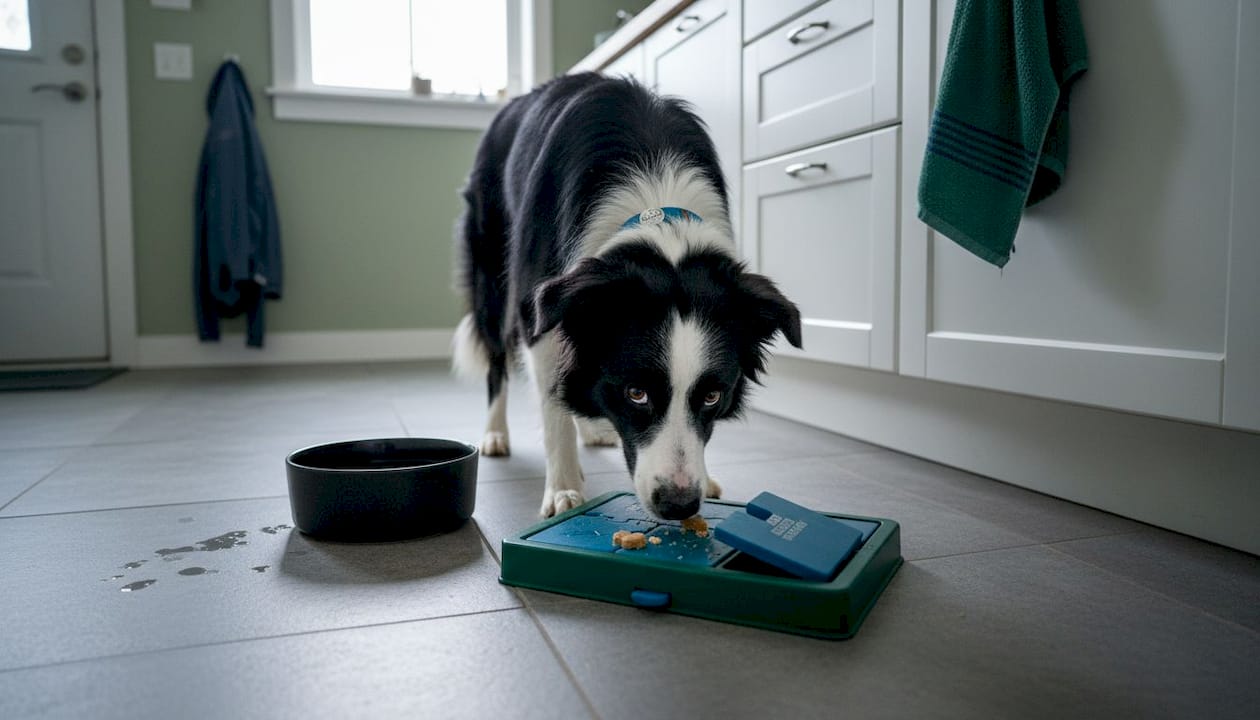
Stuffable toys like Kongs are filled manually and can be used fresh or frozen. A frozen stuffed toy can hold a dog’s attention for 20 to 30 minutes and is commonly used during crate training to build positive associations with confinement.
Regular toys without a food component can entertain, but they do not consistently reinforce behaviors the way treat toys do. Treat dispensing toys serve as tools for positive reinforcement by rewarding dogs with treats upon successful interaction, which enhances engagement and obedience in a measurable way.
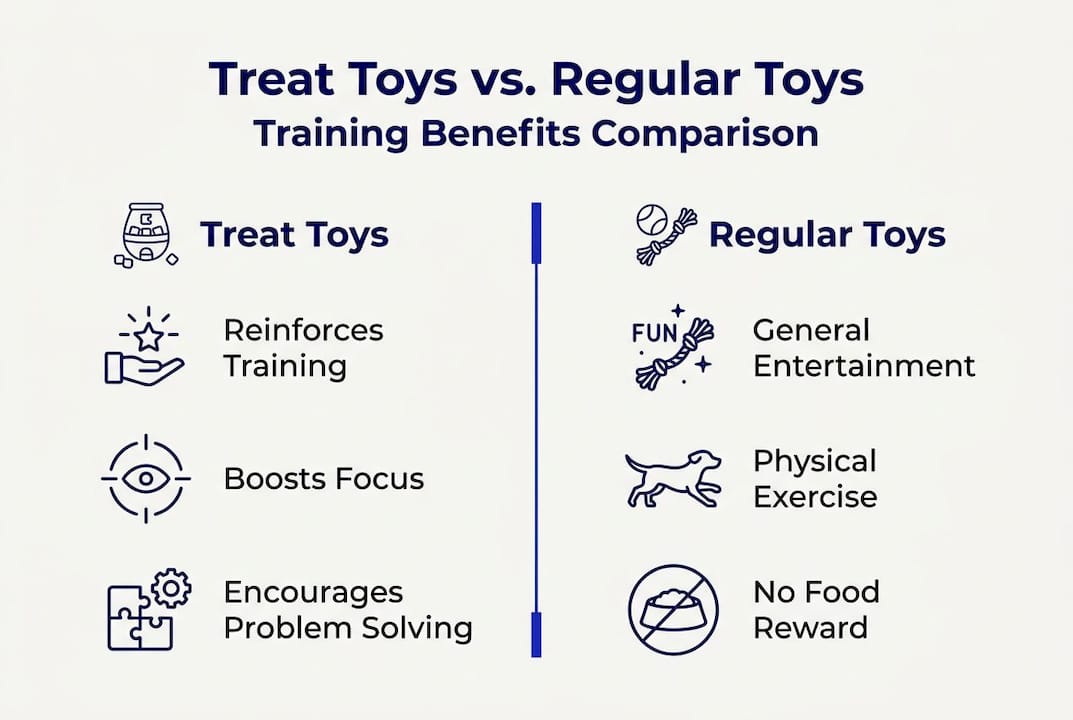
| Toy type | Primary mechanism | Best training use | Engagement duration |
|---|---|---|---|
| Treat-dispensing | Random reward delivery | Focus and patience | 10 to 20 minutes |
| Puzzle toy | Problem solving | Mental stimulation | 15 to 30 minutes |
| Stuffable (Kong) | Sustained licking/chewing | Crate training, calm | 20 to 40 minutes |
| Regular toy | Play without food | Social play only | Varies widely |
Key benefits at a glance:
- Reinforces obedience without verbal commands alone
- Reduces boredom-driven behaviors like excessive barking and destructive chewing
- Builds focus and impulse control
- Creates positive associations with crates, new environments, and training sessions
Understanding why dogs chew and how toys help is also useful context here. Chewing is a natural outlet for stress and excess energy, and treat toys redirect that energy productively.
The science behind treat toys and positive reinforcement
With a variety of treat toys in mind, it helps to understand why they work so well at shaping behavior.
Dogs display a behavior called contrafreeloading. This means they often prefer to work for their food rather than eat it from a stationary bowl. Studies on multiple species, including dogs, show that given the choice between food in a dish and food that requires effort to obtain, many animals choose the effort. This is not a quirk. It reflects how animals are wired to stay engaged with their environment.
This has a direct training application. When you use a treat toy, you are not just delivering a reward. You are activating the part of your dog’s brain associated with seeking and problem solving. That state of active engagement makes learning more durable.
Empirical research on dog training methods confirms that positive reinforcement with food or play rewards correlates with higher obedience scores and fewer problem behaviors compared to punishment-based methods. Dogs trained with aversive techniques may comply in the short term, but they tend to show higher rates of anxiety, aggression, and avoidance behaviors over time.
| Training method | Obedience outcome | Problem behavior rate | Dog stress level |
|---|---|---|---|
| Positive reinforcement (food/play) | High | Low | Low |
| Punishment-based | Variable | High | High |
| Mixed methods | Moderate | Moderate | Moderate |
| No structured training | Low | High | Variable |
“Fifteen minutes of puzzle play can provide the mental equivalent of an hour-long walk. The dog works harder cognitively, and the result is a calmer, more focused animal after the session.”
This matters for busy owners. If a full walk is not possible, a well-designed puzzle session can fill part of that gap. It does not replace physical exercise entirely, but it addresses the mental fatigue component that many dogs lack.
How to use treat toys in daily training sessions
Knowing why treat toys work, the next step is applying that understanding to your daily routines.
The biggest mistake owners make is leaving treat toys out all the time. When a toy is always available, it loses value. The goal is to make it a high-value item the dog associates specifically with training, crate time, or focused sessions.
Here is a step-by-step approach based on recommended enrichment methodology:
- Start with loose kibble. Place the dog’s regular kibble inside a treat-dispensing ball or simple puzzle. This keeps the caloric load neutral and introduces the concept without overfeeding.
- Pair the toy with a specific cue. Before handing over the toy, ask for a sit or a down. The treat toy becomes the reward for that behavior, not just a freebie.
- Increase difficulty gradually. Once the dog solves the beginner puzzle easily, move to a more complex one. Use hide and seek puzzle toys to layer in an extra challenge.
- Use stuffed toys for recall practice. Call your dog to you, and when they arrive, reward them by producing the stuffed toy. This makes the recall cue predict something far more exciting than a dry biscuit.
- Apply impulse control exercises. Place the treat toy on the ground and ask for a “leave it” before releasing the dog to interact. This builds the pause between stimulus and response, one of the hardest skills to teach.
- Rotate fillings. Peanut butter one day, mashed banana the next, kibble soaked in broth after that. Variety keeps the dog guessing and prevents the toy from becoming routine.
Common mistakes to avoid:
- Using the same toy every single session until the dog ignores it
- Overfilling toys so the dog empties them in under a minute
- Allowing unsupervised access with treats still inside, especially for chewers who may destroy the toy quickly
Pro Tip: Freeze stuffed toys overnight. A frozen stuffing takes significantly longer to empty, which extends the training value and the calming benefit, especially useful before a vet visit or during thunderstorms.
Breed differences, edge cases, and safety considerations
While treat toys work for most dogs, practical experience shows there are real exceptions and safety steps that matter.
Not every dog will charge at a treat toy the first time you present one. Some dogs, particularly those with fearful or anxious temperaments, may be startled or confused by a rolling, rattling toy. Timid dogs need gradual introduction rather than being left alone with an unfamiliar object and expected to figure it out.
Breed tendencies also play a role. Food-motivated breeds like Labrador Retrievers, Beagles, and Basset Hounds will typically engage with treat toys immediately and enthusiastically. Toy-driven breeds like Border Collies and Belgian Malinois may prefer motion-based rewards over food, meaning a treat toy alone may not hold their attention the way it would for a Labrador.
Important safety points:
- Supervision is key for new toys. Always watch your dog with a new toy the first several times to ensure they are not ingesting pieces.
- Match toy durability to chew strength. A soft puzzle toy designed for gentle chewers will not survive five minutes with a powerful chewer. Check out dog toy safety tips to understand durability ratings.
- Watch for over-arousal. Some dogs get so fixated on a treat toy that they cannot calm down after the session. Signs include panting, pacing, or inability to settle. If this happens, shorten the sessions and pair the toy with a calming cue.
- Replace damaged toys promptly. Broken pieces become choking hazards, especially in toys with small moving parts.
- Be cautious with multi-dog households. Food-based toys can trigger resource guarding between dogs. Introduce treat toys separately in multi-dog homes.
Pro Tip: For shy or easily startled dogs, start by simply letting them sniff the toy while treats are scattered nearby, not inside. Build the association that the toy predicts good things before asking the dog to interact with it directly.
Expanding your reward toolkit: Alternatives and balance
Finally, to keep your dog’s motivation high and balanced, it pays to diversify your rewards.
Treat toys are a strong tool, but variety prevents habituation. When one reward type is used exclusively, its value tends to decrease over time. Rotating between food treats, puzzle play, tug games, fetch, and affection keeps the dog’s engagement from plateauing.
Some dogs are not highly food-motivated at all, particularly in stimulating environments. In those cases, toys for non-food-motivated dogs become more effective rewards than any stuffed Kong. Alternatives like squeaky toys can serve as high-value reinforcers for these dogs.
For dogs on weight-management diets or with food allergies:
- Use low-calorie fillings such as plain carrots, cucumber slices, or green beans
- Count treat toy calories toward the dog’s daily food allotment, not as extras
- Consult your vet before using any new food items in treat toys
- Consider non-food puzzle toys that use scent or movement as the reward mechanism
While reward-based methods are consistently superior to punishment-based ones for obedience outcomes, no single tool guarantees results. A dog trained with only treat toys and no variation in reward type can become dependent on that specific context, meaning the behavior may not transfer to real-world situations where a treat toy is not present. Balance is the goal.
A balanced toolkit looks like this:
- Treat toys for sustained focus and crate training
- Food treats for rapid-fire obedience repetitions
- Play rewards (tug, fetch) for high-energy dogs and drive-building
- Calm praise and petting for low-arousal reinforcement and bonding
What most guides miss about treat toys and training
Most guides on treat toys focus on product recommendations and basic stuffing ideas. That is useful, but it leaves out something more important.
Simply putting food inside a toy and handing it to your dog is not training. It is just feeding in a different container. The actual training value comes from how you structure the interaction around the toy, when you introduce it, what behavior precedes access to it, and how you use the dog’s reaction to it as information.
Treat toys reveal a lot about a dog’s learning style. A dog that solves a puzzle quickly and moves on may need more challenge to stay engaged. A dog that gives up immediately may have low frustration tolerance, which is a skill that needs direct work, not an easier toy. A dog that becomes frantic around treat toys may have underlying anxiety that food is masking rather than resolving.
There is also a confidence angle that rarely gets discussed. When a dog works through a difficult puzzle and succeeds, that experience builds a track record of problem-solving. Over time, dogs with regular enrichment exposure tend to approach novel situations with more calm and persistence. This is not a small thing. Understanding the root causes of chewing and other problem behaviors often reveals that the underlying issue is a lack of cognitive outlets, not stubbornness or disobedience.
The takeaway: use treat toys as a diagnostic and developmental tool, not just a distraction device. Sustainable training is built on variety, adaptability, and reading your dog accurately. Toy dependence is a real risk when owners rely on a single tool, but used thoughtfully, treat toys are among the most efficient training investments available.
Recommended treat toys and training tools
Ready to try these strategies with your own dog? Here are some top picks to get you started.

At Ascencion Gear, the treat toy lineup includes options for every training stage and dog size. Start with the interactive treat dispenser for daily kibble feeding with a training twist. For dogs ready for a bigger challenge, the puzzle toy set adds layers of problem-solving that keep engagement high session after session. Both ship across the US and are built to handle consistent daily use. Browse the full selection at Ascencion Gear to find the right fit for your dog’s size, chew strength, and training goals.
Frequently asked questions
How often should I use treat toys during training sessions?
Treat toys can be used daily, but keeping them exclusive to training or crate time preserves their value as a high-priority reward and prevents the dog from tuning them out.
Are treat toys safe for unsupervised use?
Supervision is recommended, particularly with destructible toys. Research notes that treat toys are unsuitable unsupervised if destructible, as broken pieces create ingestion hazards.
What if my dog loses interest in treat toys?
Rotate toy types, fillings, and reward combinations. Variety prevents habituation, and switching between food types, textures, and toy formats keeps the novelty factor working in your favor.
Are treat toys effective for dogs with dietary restrictions?
Yes, with substitutions. Vet-approved low-calorie foods like plain vegetables work well as fillings, and diet-restricted dogs can also benefit from non-food puzzle toys that use scent or motion as the reward.
Does research show treat toys directly improve obedience?
Direct benchmarks for treat toys specifically are limited, but reward-based methods overall consistently outperform punishment-based approaches in obedience outcomes across multiple studies.
Recommended
- Holiday dog toy guide: Stay safe and have fun – Ascencion Gear
- Why dogs chew destructively: causes, solutions, and best toys – Ascencion Gear
- Holiday dog accessories guide: fun, durable, and themed picks – Ascencion Gear
- Dog birthday gift checklist: Unique ideas for every pup – Ascencion Gear
- Feed your dog real food: a practical how-to guide – Mindful Botany Market