

Most puppy owners assume any toy will do the job. Grab something squeaky, toss it across the floor, and call it enrichment. But not all toys support learning, and the wrong choice can actually reinforce bad habits. Training toys have a specific role: they build focus, reward good behavior, and give your puppy something constructive to do with all that energy. This guide covers evidence-based choices, safety benchmarks, and practical steps so you can use training toys to make every session count.
Table of Contents
- Why training toys matter: Motivation, engagement, and enrichment
- Core types of puppy training toys and how to use them
- Safety and durability: Choosing the right training toys for your puppy
- Does play really improve puppy learning outcomes?
- Maximizing success: Integrating toys, training, and owner interaction
- What most puppy toy guides miss: Why structure beats variety every time
- Explore our most popular puppy training toys and supplies
- Frequently asked questions
Key Takeaways
| Point | Details |
|---|---|
| Motivation matters | The right training toys increase your puppy’s attention and reward motivation during learning. |
| Safety and durability first | Always choose toys that are tough, appropriately sized, and free from dangerous parts to protect your puppy. |
| Purposeful play works best | Structured, short sessions using toy rewards help build good habits more reliably than constant, unsupervised toy access. |
| Toys support, not replace, teaching | Owner-led training sessions are still essential even when using enrichment and training toys for better obedience. |
Why training toys matter: Motivation, engagement, and enrichment
A basic chew toy keeps a puppy busy. A training toy builds a skill. That distinction matters far more than most new owners realize, especially in the first few months when habits form fast.
Training toys function as motivational rewards that increase engagement during puppy training when puppies “earn” them through good behavior. That earning mechanism is key. When a toy appears only after a correct response, the puppy learns that listening pays off. The toy becomes a signal, not just a distraction.
AKC guidance supports puzzle toys and hidden-food toys as cognitively challenging enrichment tools, even during times when you are not actively running a session. That means your puppy can keep practicing problem-solving on their own while you handle other tasks. Mental stimulation and basic training reinforce each other.
Training toys serve several specific roles:
- Reward tool. Replace or supplement treats with toy rewards to maintain motivation without overfeeding.
- Enrichment device. Puzzle and treat-dispensing toys keep puppies occupied and mentally active during downtime.
- Impulse control tool. Tug toys and fetch items teach a puppy to start and stop on command.
- Distraction manager. A well-placed chew toy redirects a puppy away from furniture, shoes, or other off-limit items.
For treat toy training strategies that go deeper on the reward side of this equation, the connection between food-based toys and structured training sessions is worth understanding early.
Core types of puppy training toys and how to use them
Every toy category has a job. Matching the toy to the goal is what separates effective training from random play.
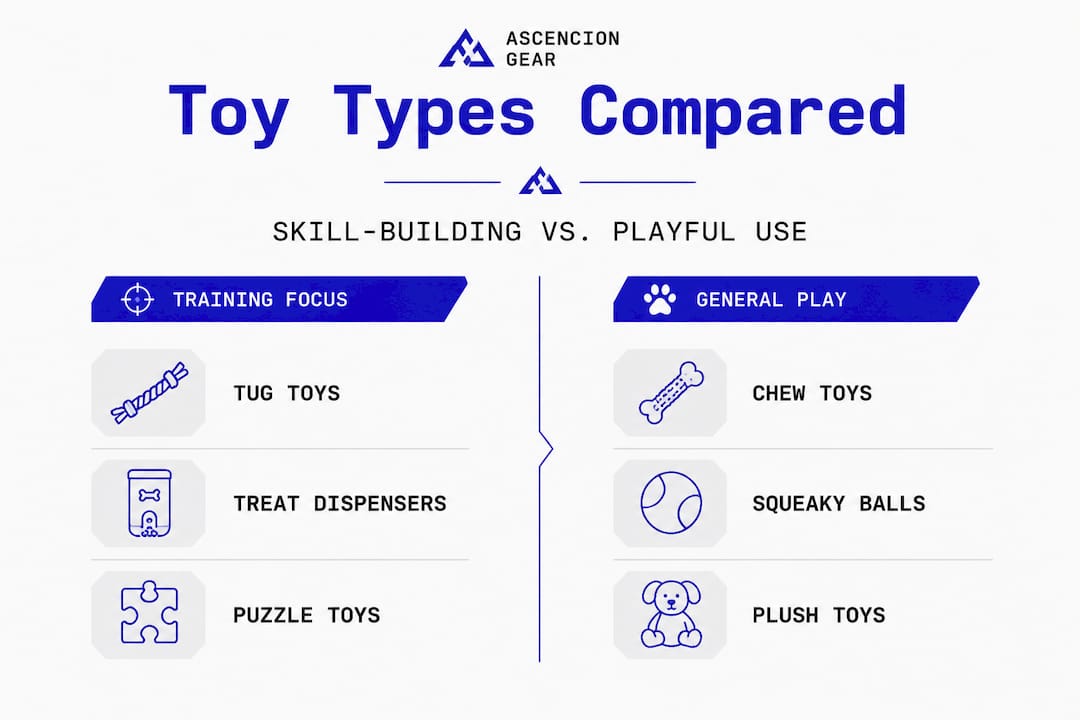
| Toy type | Pros | Cons | Best use |
|---|---|---|---|
| Tug toy | Builds drive, great reward | Can overstimulate | Impulse control, recall reward |
| Puzzle toy | Mental enrichment, solo use | Can frustrate beginners | Independent problem-solving |
| Treat dispenser | Motivating, extends engagement | Calorie-heavy if overused | Focus training, slow feeding |
| Scented chew toy | Redirects mouthing, high engagement | Supervision required | Teething, chew behavior |
| Plush (no stuffing) | Soft, safe for gentle chewers | Low durability | Comfort, light interactive play |
Tug toys can be effective training tools when used with impulse control, a trained release cue, and short controlled sessions. The key is always starting and stopping on your command, not the puppy’s. That structure is what builds self-regulation.
Scented chew toys increase engagement, including chewing and sniffing time, compared to unscented options. Scent appeals to a puppy’s strongest sense and keeps attention on the right object rather than your baseboards.
Here is a step-by-step approach for three common training goals:
- Impulse control with a tug toy. Hold the tug and give your cue to grab it. Let the puppy play for 10 to 15 seconds. Give your “out” or “drop” cue and stop moving the toy. Reward the release with praise or a treat. Repeat in short cycles, never longer than a few minutes total.
- Enrichment with a food puzzle. Load the puzzle with your puppy’s regular kibble, not extra treats. Present it after a training session to give the puppy something to wind down with. Start with the easiest difficulty level and move up as the puppy succeeds.
- Chewing alternatives for teething. When your puppy mouths something they should not, calmly redirect them to a scented or textured chew toy. Mark the moment they take it with a “yes” and let them chew undisturbed.
Pro Tip: Rotate your puppy’s toys every two to three days. A toy that has been out of sight feels new again, which resets motivation. Leaving every toy on the floor at once reduces the value of all of them.
Before introducing new toys to your puppy’s rotation, there are practical steps to ensure the toy does not become a source of confusion or frustration. Structured introduction matters as much as the toy itself.
For interactive puzzle options, hide-and-seek puzzle toys offer multiple engagement layers in one set, combining squeaky sounds, crinkle textures, and hidden compartments that challenge different senses at once.
Safety and durability: Choosing the right training toys for your puppy
A toy that breaks apart in a training session is not just wasteful. It is a choking risk. Safety and durability should be the first filter, before color, price, or novelty.
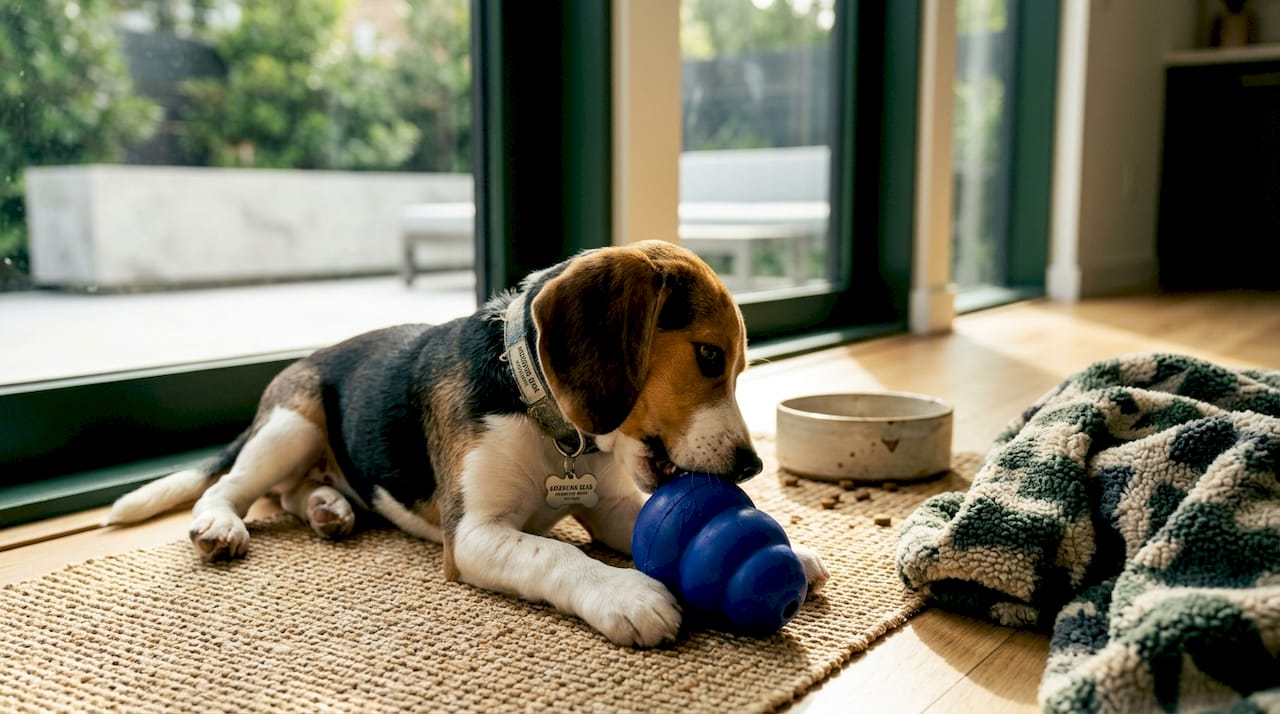
Durability and safety are central benchmarks for choosing puppy training toys, with proper sizing and material quality cited as the top selection factors. That guidance applies regardless of toy type.
| Feature | What to look for | What to avoid |
|---|---|---|
| Material | Natural rubber, thick nylon, dense plush | Cheap plastic, hollow thin shells |
| Stitching | Double-stitched seams, reinforced edges | Single thread, loose seams |
| Size | Larger than the puppy’s mouth opening | Anything that fits entirely in the mouth |
| Surface | Smooth or textured, no sharp points | Rough edges, brittle pieces |
| Fill | Minimal or no stuffing | Loose poly-fill, small foam beads |
Red flags to watch for when inspecting or buying a toy:
- Small parts that could detach (button eyes, plastic tags, sewn-in squeakers near the surface)
- Sharp seams or molded edges on hard plastic toys
- Rope toys that fray easily, since loose fibers can be swallowed
- Plush that tears apart within one or two sessions
- Any toy labeled for older dogs used with a young puppy who chews aggressively
A supervision checklist for every training session:
- Inspect the toy before use. Check for cracks, loose threads, or parts that have shifted.
- Match the size to your puppy’s current weight and jaw strength, not their breed estimate.
- Remove the toy after the session ends. Do not leave chew or tug toys with an unsupervised puppy.
- Replace toys at the first sign of significant wear, not after they fully break apart.
Pro Tip: When in doubt about sizing, go one size up. A toy that is slightly too large is always safer than one a puppy can potentially swallow or get their jaw stuck around.
The dog toy safety guide from Ascencion Gear covers material-specific advice in more detail, and understanding durable materials for puppy toys can help narrow the field before you buy.
Does play really improve puppy learning outcomes?
The short answer: sometimes, and it depends heavily on how play is structured. The long answer involves a little nuance that most toy guides skip over.
Research on the playful learning hypothesis in dogs shows that play can influence learning outcomes, but effects are not guaranteed. Results vary depending on experimental design, the individual puppy, and how training is structured around play. Less-skilled or younger puppies show more benefit. Dogs that already know a behavior well show less change from play alone.
Research findings suggest play is a useful support tool for learning, but it is not a replacement for consistent, owner-led instruction. The structure around play matters more than the play itself.
Here is what play with training toys is reliably shown to support:
- Motivation. A puppy that wants the toy works harder to earn it.
- Focus. Short, rewarding sessions keep attention on the owner rather than the environment.
- Engagement. Play maintains arousal at a trainable level, not so high the puppy cannot think, not so low they disengage.
- Stress reduction. Play before a training session can reduce anxiety and make new environments feel safer.
What play does not consistently produce:
- Faster command learning on its own
- Reliable recall or obedience without direct practice
- Behavior change without a structured cue-and-reward loop
The practical conclusion is that treat-based play and learning work best as a supporting strategy. Toys add motivation and enrichment. They do not do the teaching for you.
Maximizing success: Integrating toys, training, and owner interaction
With the right toys selected and safety covered, the next step is building a daily routine that actually uses them effectively. Consistency matters more than complexity here.
A simple daily routine for puppy toy-based training:
- Morning short session (3 to 5 minutes). One or two basic cues (sit, look at me) rewarded with a tug toy or treat toy. Keep it energetic and end on a success.
- Midday enrichment (10 to 20 minutes). Leave a loaded puzzle toy or treat dispenser for solo engagement. This builds independent focus without owner input.
- Afternoon interaction play (5 to 10 minutes). Fetch, chase, or gentle tug with clear start and stop cues. Practice impulse control during this time.
- Evening wind-down. A scented chew toy or soft plush to settle the puppy after the day’s stimulation.
Enrichment and toy play support mental stimulation, but puppy learning and bonding still depend on human-led training and direct interaction. Toys are a tool, not a substitute for your involvement.
Common mistakes that reduce toy effectiveness:
- Leaving all toys out at once, which drains their reward value
- Using the same toy for every reward, which leads to habituation
- Inconsistent cues that confuse the puppy about when the toy is available
- Skipping supervision during chew sessions, increasing safety risk
Pro Tip: End every play session with a simple sit or down command, followed by a small treat. This closes the loop, reinforces a calm finish, and builds the habit of settling after excitement.
The reward loop in puppy training is the core mechanism that makes toy rewards work. Cue, behavior, mark, reward. That four-step sequence repeated consistently is what creates reliable responses over time.
What most puppy toy guides miss: Why structure beats variety every time
Most toy guides focus on what to buy. The more useful question is how to use what you already have.
Flooding a puppy with variety sounds generous. In practice, it does the opposite of what owners intend. When every toy is always available, none of them carry weight as a reward. The why structure matters in training connection is straightforward: a toy that only appears under specific conditions becomes highly motivating. One that is always on the floor becomes furniture.
Puzzle toys and treat dispensers work best when introduced with clear intent. Placing one on the floor as background noise while you watch television is a missed opportunity. Presenting it after a training session as a structured cool-down activity is a completely different interaction that builds both independence and patience.
The cue-to-reward loop is the most underused tool in home training. When a puppy learns that a specific toy only appears after a specific behavior, they start offering that behavior unprompted to make the toy appear. That is not a trick. That is a puppy learning to communicate through structure.
Bonding is also stronger when play has boundaries. A puppy that knows play starts and ends on your terms is a puppy that looks to you for guidance. That attentiveness is the foundation of reliable obedience, and it costs nothing beyond consistency.
Make certain toys invisible between sessions. Store them in a drawer or a bag. When they reappear, the puppy’s engagement resets. That simple habit is worth more than any single toy purchase.
Explore our most popular puppy training toys and supplies
Applying these principles works best with toys that match the standards covered here: safe materials, appropriate sizing, and designs built for engagement and durability.
At Ascencion Gear, the puppy toy selection is built around those exact benchmarks. From hide-and-seek puzzle sets that combine crinkle, squeak, and hidden-compartment enrichment to curated bundles designed for new puppy owners, every product is chosen to support structured, rewarding play. Whether your puppy needs a tug toy for impulse control practice, a treat dispenser for solo enrichment, or a durable chew alternative for teething, the full range is available and ships across the US. Browse the complete training toys and accessories collection at ascenciongear.com to find the right fit for your puppy’s current stage.
Frequently asked questions
Are training toys safe for teething puppies?
Yes, as long as they are specifically designed for puppies, made from safe materials, and sized to prevent swallowing. Properly sized teething toys that are supervised for wear are the safest choice during the teething period.
How long should each toy-based training session be?
Keep sessions short to maintain focus and excitement. AKC recommends tug sessions of 10 to 15 seconds, capped with a settle exercise and the toy put away immediately after.
Do puzzle and treat-dispensing toys improve obedience?
They build mental stimulation and reduce boredom-driven behavior, but they supplement rather than replace direct teaching. Puzzle toys support mental stimulation, while core obedience depends on consistent owner-led sessions.
Can scented toys help with unwanted chewing or mouthing?
Scented toys increase engagement with appropriate objects and can reduce mouthing on off-limit items. Owners reported less problem mouthing when scented chew toys were introduced, though structured owner guidance still produces the best results.
How often should I rotate my puppy’s training toys?
Rotate toys every two to three days to keep motivation high. Avoid leaving all toys out at once, since constant access reduces the reward value that makes training toys effective in the first place.