

If you’ve watched a “tough” dog toy get reduced to shreds within the first 20 minutes, you’re not alone. Most dog owners have spent money on toys labeled “heavy duty” or “long lasting,” only to sweep up the pieces by evening. The frustrating truth is that the word “durable” gets applied loosely, and not all tough-looking toys are built the same way. This guide breaks down exactly what qualifies a toy as durable, which materials actually hold up under strong jaws, and how the engineering behind each design determines whether your dog is still playing with it a month from now.
Table of Contents
- What does ‘durable’ mean for dog toys?
- Materials that make (or break) a tough toy
- How durable dog toys work: science behind the chew
- Tips for choosing the best durable toy for your dog
- The truth most owners miss about ‘indestructible’ toys
- Find tough toys your dog can’t shred
- Frequently asked questions
Key Takeaways
| Point | Details |
|---|---|
| Material matters most | Choose toys made with rubber, Zogoflex, or dense nylon for aggressive chewers. |
| No toy is immortal | Even the toughest toys need regular monitoring and eventual replacement. |
| Match toy to dog | Select toys based on your dog’s chewing style and strength for best results. |
| Inspect and rotate | Check toys for damage and rotate them to keep your dog interested and safe. |
What does ‘durable’ mean for dog toys?
Most toys fail for one simple reason: the materials weren’t built for the force a large or aggressive chewer applies. A toy can look solid and feel firm in your hand, yet still crack, split, or tear apart under serious jaw pressure. The difference between a toy that lasts and one that doesn’t usually comes down to how the material handles force, not just how hard it is.
A truly durable dog toy doesn’t resist force by being harder than your dog’s teeth. It survives by redistributing, absorbing, or gradually reducing force over time.
True durability in dog toys is about engineering for gradual wear, not sudden breakage. Durable dog toys are primarily made from natural rubber, Zogoflex (a thermoplastic elastomer), and dense nylon, designed to withstand aggressive chewing by absorbing force, flexing, or gradually eroding rather than fracturing. Each of those three materials works differently, but all three share the same goal: survive the bite without breaking apart into dangerous pieces.
Here’s what separates durable toys from the rest:
- Materials that flex or absorb: Rubber and Zogoflex bend and stretch under load instead of cracking
- Controlled erosion design: Quality nylon toys are engineered to sand down slowly, not chip off in chunks
- No hollow thin walls: Weak spots in construction are the first place a strong chewer will break through
- Safety under failure: Even as a durable toy wears, it should not produce sharp fragments or large pieces a dog could swallow
An indestructible dog bone built from dense nylon is a good example of the erosion model. Your dog gnaws on it, tiny particles wear away, and the bone gradually reduces in size rather than snapping apart. Contrast that with a robust bear dog toy made from reinforced rubber or elastomer layers, which flexes and bounces back under each bite. Both are durable. They just work in completely different ways.
Materials that make (or break) a tough toy
Now that you know what durability means, let’s break down what makes a material tough and which ones to seek out or avoid.
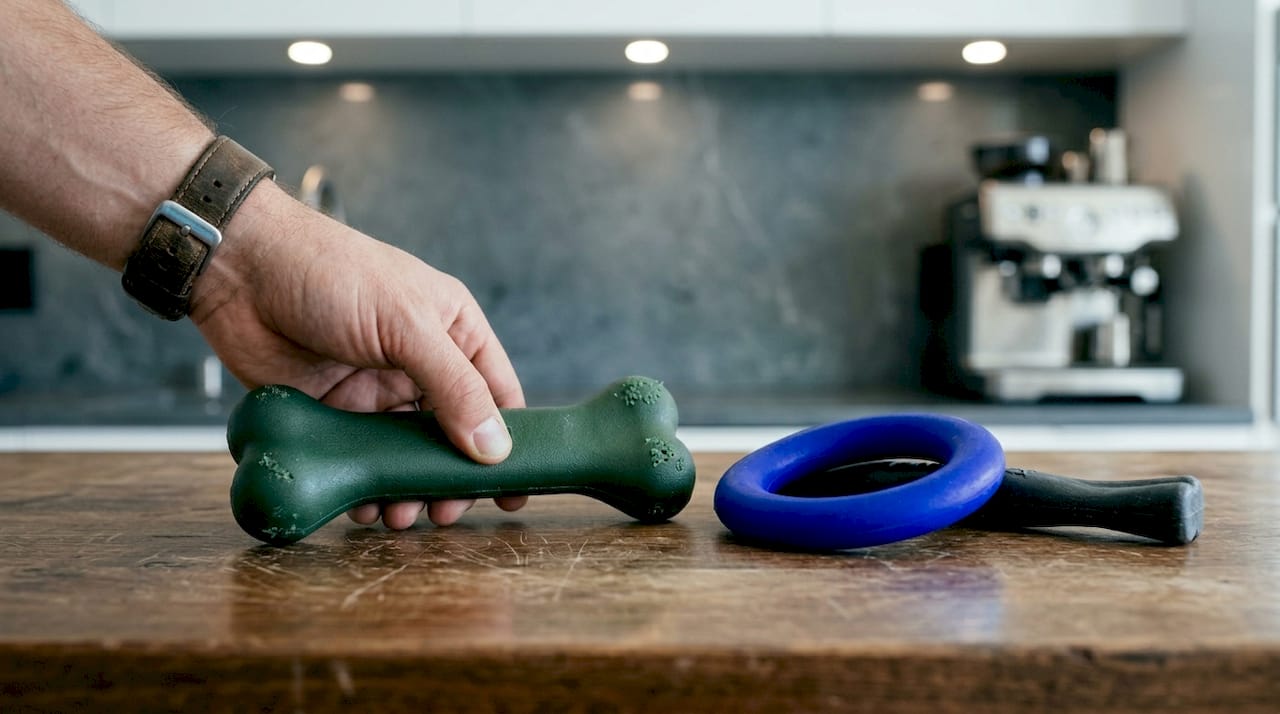
Durable dog toys are primarily made from natural rubber, Zogoflex, and dense nylon. Each one has a specific mechanical advantage, and each one has a failure point to watch for.
| Material | How it resists damage | Best for | Main risk |
|---|---|---|---|
| Natural rubber | Flexes and absorbs force | Power chewers, fetchers | Tearing if too thin |
| Zogoflex | Stretches and bounces back | All chew styles | Surface abrasions over time |
| Dense nylon | Wears down slowly via abrasion | Constant chewers | Cracks if force exceeds enamel hardness |
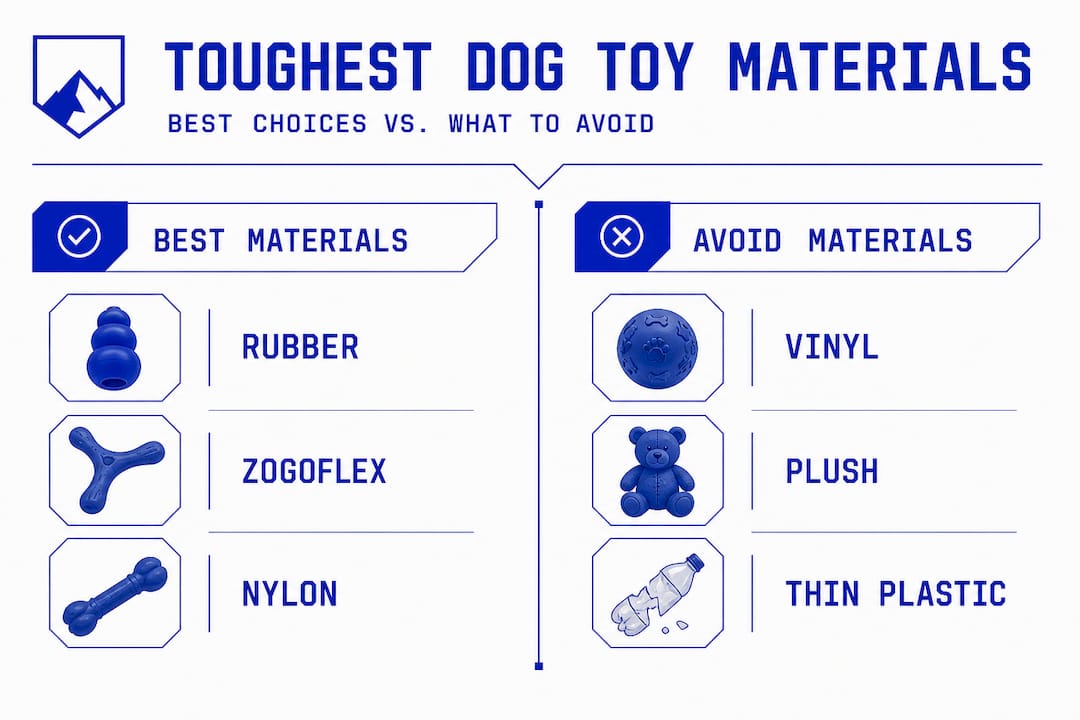
Natural rubber offers flexibility rates between 200 and 800 percent elongation before breaking. That means when your dog bites down, the rubber stretches and returns to shape instead of fracturing. The mechanics behind rubber and Zogoflex involve absorbing and distributing jaw force through flex and elongation at 200 to 800 percent, preventing brittle failure entirely. The main downside is that thinner rubber walls can eventually tear from sustained aggressive chewing.
Zogoflex is an engineered thermoplastic elastomer created specifically for dog toys. It combines the flex of rubber with better resistance to abrasion, and it’s also dishwasher safe. It tends to hold shape longer than natural rubber and works well for dogs who both chew and play fetch. The mighty bear toy design uses this type of reinforced construction, blending squeaker protection with an outer layer that bends rather than breaks.
Dense nylon works through a completely different model. It doesn’t flex. Instead, nylon toys are designed to be slightly softer than tooth enamel, so your dog’s gnawing motion grinds away tiny bits of material gradually. This is intentional. Nylon toys grind down via abrasion, but they risk propagation cracks if bite force exceeds tooth enamel hardness at approximately 400 Vickers. In practical terms, if the nylon toy is too hard (harder than your dog’s teeth), it can damage teeth rather than wearing down the toy.
Pro Tip: Press your thumbnail firmly into a nylon toy before buying. If you can’t leave any mark, the toy may be too hard for your dog and could risk cracking teeth during heavy chewing.
The nylon chew toys designed for aggressive chewers typically come in a two-pack because even well-designed nylon toys eventually wear down. Having a second one ready extends playtime without a gap in enrichment.
How durable dog toys work: science behind the chew
With the core materials explained, let’s see how these play out mechanically when your dog bites down.
When a dog closes its jaws on a toy, the force concentrates at the contact point. A large dog can generate between 150 and 320 pounds of force per square inch. That force has to go somewhere. In a poorly designed toy, it travels to a weak seam or thin wall and causes a fracture. In a well-designed durable toy, the force is spread outward and absorbed by the material itself.
Rubber and Zogoflex absorb and distribute jaw force through flex and elongation, preventing brittle failure. Nylon grinds down via abrasion but can develop propagation cracks over time. Here’s how the two models compare in practice:
| Toy type | Force response | Wear pattern | Failure mode |
|---|---|---|---|
| Rubber or Zogoflex | Stretches, bounces back | Surface scoring, gradual compression | Tearing at thin points |
| Dense nylon | Resists deformation | Slow surface erosion | Crack propagation from stress points |
There are four key design features that determine how well a toy handles repeated biting:
- Wall thickness: Thicker walls distribute force over a wider area, reducing stress at any single point
- Shape geometry: Round or oval shapes have no corners where cracks tend to start
- Material consistency: Uniform density prevents internal weak spots that aren’t visible from outside
- Surface texture: Ridges and bumps redirect bite pressure across more surface area
The slingshot bone toy is a good example of shape geometry in action. Its elongated design with no sharp corners means bite pressure travels along the length of the toy rather than concentrating at one spot.
Understanding your dog’s chewing style also matters here. Some dogs are power biters who clamp and hold. Others are shakers who grab and thrash. Thrashing puts a very different type of stress on a toy than sustained biting. Rubber and Zogoflex handle both styles well because they flex in multiple directions. Nylon handles sustained biting better than thrashing, which can cause thin nylon sections to snap unexpectedly.
Tips for choosing the best durable toy for your dog
We’ve covered what makes toys tough. Here’s how to choose and manage them wisely for your individual dog.
The most important factor in toy selection isn’t the brand or the price. It’s matching the toy’s design to your dog’s actual jaw strength and play style. A toy designed for medium breeds will not hold up to a 90-pound Rottweiler. Conversely, an extreme-duty nylon bone built for giant breeds may be too hard for a smaller aggressive chewer and risk dental damage.
Here’s a practical checklist for selecting the right durable toy:
- Match the size rating to your dog’s weight, not breed alone. A compact but muscular dog may need a toy rated for a larger size class
- Check the material hardness. Use the thumbnail test for nylon toys before buying
- Look for seamless or reinforced construction. Seams and joins are the most common failure points in tough toys
- Avoid hollow toys for strong chewers. Hollow centers collapse under high bite force and can create sharp edges
- Read reviews specifically from owners of similar-sized dogs. A toy that lasts for one dog may fail quickly for another with different chewing habits
Durable dog toys are designed to withstand aggressive chewing by absorbing force, flexing, or gradually eroding rather than fracturing. That design intent only holds up if you match the toy to the dog.
Supervision matters especially with new toys. Even the toughest toy can fail in unexpected ways with a new dog. Spend the first few sessions watching how your dog interacts with a new toy. Look for bite spots, unusual wear patterns, or any tendency to dig at seams.
Pro Tip: Rotate between two or three toys rather than leaving one toy out full time. Rotation keeps your dog mentally engaged with each toy and reduces total wear on any single item.
The nylon chew bones two-pack is built for this rotation strategy. Two bones in the set means you can alternate daily while each toy gets a break and a wash between sessions. For dogs who need more variety across different toy types, the aggressive chewer bundle covers rubber, nylon, and interactive styles in one purchase.
Once a toy shows deep gouges, missing chunks, or sharp edges anywhere on its surface, retire it. No durable toy lasts forever, and a worn-out toy that fragments can cause internal injuries or intestinal blockages.
The truth most owners miss about ‘indestructible’ toys
Here’s the hard truth: no toy company can guarantee a toy will survive every dog. The word “indestructible” is marketing language, not an engineering certification. Every material has a fatigue point, and every dog with a strong enough jaw and enough time will eventually compromise even the toughest toy available.
The real goal isn’t to find an eternal toy. It’s to find a toy that lasts long enough to give your dog consistent enrichment, wears predictably rather than catastrophically, and stays safe throughout its lifespan. That’s a more practical and achievable target.
What most owners miss is that mental enrichment matters as much as physical gnawing. A dog that chews destructively is often under-stimulated. Adding toys that engage problem-solving, like a durable squeaky toy for chewers that rewards the dog with sound during play, can reduce the intensity of destructive chewing sessions by redirecting that energy.
Smart owners build a system around toy management rather than searching for one perfect toy. That system includes regular inspection, rotating multiple toys, replacing worn items promptly, and choosing toys matched to the dog’s actual chewing profile. This approach saves money over time, prevents emergencies, and keeps dogs consistently engaged.
One more thing worth saying directly: spending more money does not always mean more durability. Some expensive toys fail faster than budget options because the design doesn’t match the dog. Material and construction quality matter far more than price point or brand name recognition.
Find tough toys your dog can’t shred
Ready to upgrade your dog’s playtime with toys that are actually built for aggressive chewers?
At Ascencion Gear, you’ll find a curated selection of rubber, nylon, and interactive tough toys matched to different chewing styles and dog sizes. From the textured dinosaur egg dog toy that satisfies gnawing instincts to the multi-piece aggressive chewer bundle that covers rubber, nylon, and interactive play in one set, there’s a solution for every dog’s needs. Browse the full Ascencion Gear collection to find toys, bundles, and accessories built for dogs who play hard. Every item ships across the US.
Frequently asked questions
Are any dog toys truly indestructible?
No dog toy is truly indestructible, but toys made from rubber, Zogoflex, or dense nylon last much longer for aggressive chewers than standard materials.
What are the safest materials for tough dog toys?
The safest options are natural rubber, Zogoflex, and nylon. These materials withstand hard chewing without shattering into sharp fragments that could injure your dog.
How do I know if a toy is too hard for my dog?
If you can’t dent the toy with your thumbnail, it’s likely harder than your dog’s teeth. Nylon toys that are too hard risk propagation cracks at approximately 400 Vickers hardness, which can also damage tooth enamel.
What’s the best type of toy for an aggressive chewer?
Aggressive chewers do best with solid rubber, Zogoflex, or nylon toys specifically rated for large breeds and heavy chewing, not general-purpose plush or hollow toys.
How often should I replace a durable dog toy?
Inspect toys every week and replace any with deep cuts, missing chunks, or sharp edges. Even well-built toys degrade over time, and a damaged toy poses a real swallowing or injury risk.
Recommended
- Indestructible Dog Bone | Beef Flavored Nylon Chew Toy | Ascencion Gear
- Mighty Bear 2.0 Dog Toy - Durable Squeaky Toy for Aggressive Chewers – Ascencion Gear
- Indestructible Robust Bear Dog Toy - Durable Squeaky for Heavy Chewers (Blue) – Ascencion Gear
- Holiday dog accessories guide: fun, durable, and themed picks – Ascencion Gear
- Natural Rubber Jack Dog Toy – Durable, Non-Toxic Chew Toy for Engaging – Mindful Botany Market