

Most dog owners buy accessories the same way: they see something, it looks right, they buy it. Then the toy shreds in an hour, the harness slips, or the collar sits wrong and their dog refuses to wear it. A solid dog accessory selection workflow stops that cycle before it starts. This guide walks you through a step-by-step process for choosing accessories based on your dog’s actual needs, covering chew strength, safety fit, material durability, and long-term engagement so every purchase works the first time.
Table of Contents
- Key takeaways
- Your dog accessory selection workflow starts here
- What to look for in toys and gear
- How to test and introduce new accessories
- Common mistakes that break the workflow
- What a good workflow actually delivers
- My take on selecting dog accessories
- Find gear that fits your workflow at Ascenciongear
- FAQ
Key takeaways
| Point | Details |
|---|---|
| Assess your dog first | Classify chew strength, size, and behavior before buying any accessory. |
| Size toys for safety | Choose toys larger than your dog’s full mouth opening to prevent choking. |
| Fit harnesses with the two-finger rule | Two fingers under each strap confirms a safe, secure fit every time. |
| Inspect and replace proactively | Replace damaged toys immediately to eliminate ingestion and blockage risk. |
| Rotate toys to hold interest | Cycling toys by activity type extends their life and maintains engagement. |
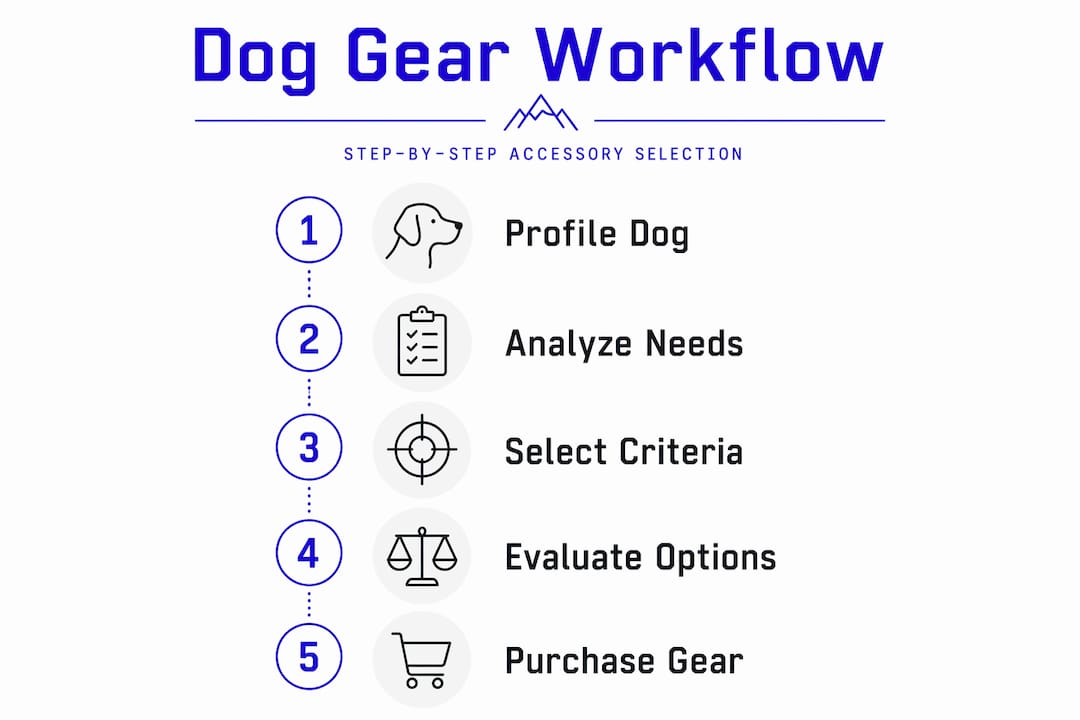
Your dog accessory selection workflow starts here
Before you open a product page, you need a clear profile of your dog. That profile drives every decision in the workflow.
Start by watching how your dog plays. Does your dog mouth gently, or does your dog bear down and destroy? This is your chew classification. Light chewers can handle plush and soft rubber. Moderate chewers need reinforced rubber or nylon. Power chewers need dense rubber toys rated for aggressive chewing, nothing less.
Beyond chewing, note engagement patterns. Does your dog lose interest in toys within minutes, or play for extended sessions? Dogs that disengage fast benefit from puzzle-style or squeaky toys that add sensory variety. Dogs that stay locked in during play can handle simpler, tougher formats like fetch balls or rings.
A few factors to observe and record:
- Breed and size. Large breeds often need bigger toys to avoid accidental swallowing. Small breeds need smaller, lighter accessories to avoid strain.
- Age. Puppies have developing teeth. Senior dogs may have dental sensitivities. Both groups need softer materials than healthy adult dogs.
- Behavioral triggers. Anxiety-driven chewing is different from play-driven chewing. Anxious chewers destroy faster and need more durable options.
- Material sensitivities. Some dogs react to rubber compounds or dyes. If your dog has shown skin or digestive sensitivity, prioritize natural or hypoallergenic materials.
- Body measurements. For harnesses and collars, measure neck circumference, chest girth, and body length before selecting. Never rely on breed labels alone since body shape varies widely within breeds.
Pro Tip: Write down your dog’s chew profile and measurements before you shop. It takes three minutes and eliminates 80% of poor accessory choices.
What to look for in toys and gear
With your dog’s profile in hand, you can now apply specific criteria to every product you consider. This is where most guides stop at “buy durable toys.” Here is what that actually means in practice.
Material and failure mode
Durability is not just strength. The better standard is predictable failure mode. A toy that wears down evenly and slowly is far safer than one that holds up perfectly until it suddenly splits into sharp pieces. Look for toys that show visible surface wear before structural failure. That gives you time to replace them before they become hazards.

For hardness, use the thumbnail test. Press your thumbnail into the toy surface firmly. If the toy leaves no indentation at all, it is too hard and risks fracturing your dog’s teeth. Flexible materials that show slight give under pressure are the standard for safe chew toys.
Sizing rules for toys
Size is a safety decision, not a preference. Choose toys larger than your dog’s full mouth opening so the toy cannot be swallowed in one motion. For medium and large dogs especially, undersized toys are the most common cause of choking incidents during unsupervised play.
| Dog size | Recommended toy size | Material priority |
|---|---|---|
| Small (under 20 lbs) | 3–4 inches minimum | Soft rubber, light plush |
| Medium (20–50 lbs) | 4–6 inches minimum | Dense rubber, reinforced plush |
| Large (50–90 lbs) | 6+ inches minimum | Thick rubber, nylon-reinforced |
| Power chewer (any size) | Add 2 inches to standard | Heavy-duty rubber only |
Harness fitting criteria
For harnesses, two standards matter most. First, the two-finger rule is the industry benchmark: two fingers should fit snugly but not loosely under every strap. Too tight causes chafing and restricted movement. Too loose allows escape or shifting during walks.
Second, strap placement matters. The chest strap must sit across the sternum, not near the throat. Throat placement causes tracheal pressure with every step. A front-clip harness reduces pulling force without adding stress compared to back-clip designs, making it a stronger choice for dogs that pull on walks.
Pro Tip: When you buy a harness online, check whether the size chart uses measurements or weight. Measurement-based charts are far more accurate.
How to test and introduce new accessories
This is where the workflow gets procedural. Follow these steps with every new accessory, whether it is a toy, harness, or collar.
-
Set aside supervised introduction time. The first 30 minutes with a new toy reveals the most about its appropriateness for your dog. Watch for aggressive pulling, attempts to shred seams, or loss of interest. Do not leave your dog alone with an untested toy.
-
Adjust harnesses from factory settings. Most harnesses ship with default strap lengths that fit no real dog well. Before your first walk, loosen every strap fully, put the harness on, then tighten each strap gradually until you reach two-finger fit on all points.
-
Use positive reinforcement during gear introduction. New harnesses and collars feel unfamiliar to dogs. Pair the first few wearings with treats and short sessions. Dogs that associate gear with rewards accept it faster and show less resistance over time.
-
Establish an inspection routine. After every play session, run a quick check on toys. Look for separated seams, cracked rubber, missing squeakers, or torn fabric. If the toy shows any structural change that creates a sharp edge or loose piece, remove it immediately. The ASPCA is explicit that fragmented toys carry blockage and choking risks.
-
Track engagement over time. Note whether your dog still engages with a toy after two weeks. If engagement drops, that toy belongs in a rotation, not permanent use. Toys with enrichment features like texture variation, squeaks, or hidden compartments hold attention longer than single-format toys.
A good workflow does not end at purchase. It continues through introduction, adjustment, inspection, and rotation. Every step reduces risk and extends the life of your investment.
Common mistakes that break the workflow
Even with good criteria, specific errors derail the canine accessory decision process. These are the most common ones.
- Skipping harness adjustment. Most owners fail to adjust harnesses after unboxing. A factory-set harness rarely fits correctly and leads to chafing, shoulder interference with natural gait, or a dog that backs out of it on walks.
- Taking “indestructible” claims at face value. No toy is indestructible for a determined power chewer. The more useful question is how long a toy lasts and how it fails. Look for predictable wear patterns rather than marketing claims.
- Not rotating toys. Leaving the same toys out constantly accelerates wear and reduces interest. Rotating toys by activity type balances wear across your collection and keeps your dog more engaged.
- Ignoring breed-specific body proportions. A deep-chested dog like a Greyhound or Whippet needs a harness designed for narrow waists and wide chests. Standard sizing will not apply. Check manufacturer notes for breed-specific fit guidance before buying.
- Buying accessories based on size breed labels alone. A 40-pound Bulldog and a 40-pound Labrador Retriever have completely different body shapes. Measurements beat breed generalizations every time.
Pro Tip: Keep a small log or note on your phone of every accessory your dog has owned, how long it lasted, and why you replaced it. Over six months, patterns emerge that make future buying much faster.
What a good workflow actually delivers
The practical results of a disciplined dog accessory selection workflow are specific and measurable. You can track them.
Dogs given properly sized, material-appropriate toys show reduced anxiety-driven chewing behavior because enrichment needs are actually being met. Boredom-driven destruction drops. Dogs with well-fitted harnesses walk more comfortably, which leads to longer and more consistent training sessions. And when you build in proactive inspection and replacement, you spend less money long-term because you catch wear before a toy becomes a vet visit.
The workflow also benefits training. Gear that fits properly gives you better control and faster cue response. Dogs do not resist properly fitted harnesses the way they resist uncomfortable ones. That compliance compounds over time into a calmer, more responsive dog on the leash.
My take on selecting dog accessories
I have watched dog owners spend real money on gear that ends up in the trash within a week, and almost every time, the problem was the same. No assessment step. The workflow starts before you buy anything.
What changed my approach most was taking harness fitting seriously. I used to trust the sizing chart, put it on, and call it close enough. Then I watched a dog back out of a “properly sized” harness on a busy sidewalk. After that, the two-finger check became a non-negotiable for me on every strap, every time.
The other lesson I keep coming back to is toy rotation. It sounds like a minor detail, but cycling toys by activity type genuinely extends how long each toy holds interest. Dogs that used to ignore a toy after a few days started re-engaging with it weeks later after it had been out of rotation. That is not magic. It is just how novelty works.
The mistake I see most often is over-relying on marketing language. Durability ratings and “tough chewer” labels vary wildly by brand. What matters is whether the toy wears down predictably and whether you are checking it regularly. You can learn more about what real quality looks like in an accessory by focusing on construction details rather than label claims.
Individual dogs will always require you to adjust the workflow. What works for a 60-pound retriever will not work for a 12-pound terrier with a destructor-level chew drive. Build the framework, then adapt it to your dog.
— Thomas
Find gear that fits your workflow at Ascenciongear
Once you have your dog’s profile and criteria in place, the next step is finding accessories that actually meet them. Ascenciongear carries toys, harnesses, beds, and bundles selected for dogs across all size ranges and chew levels. If your dog is a power chewer, the squeaky no-stuffing chew toy is designed to hold up to aggressive mouthing while keeping engagement high. For dogs that need mental stimulation alongside physical play, the octopus puzzle toy set offers a four-pack of hide-and-seek squeaky toys built for exactly that. Each product page includes sizing guidance so you can apply the criteria from this workflow before you add anything to your cart.
FAQ
What is the first step in a dog accessory selection workflow?
The first step is assessing your dog’s chew strength, size, body measurements, and behavioral patterns. This profile determines which materials, toy sizes, and harness styles are appropriate before you evaluate any product.
How do I know if a harness fits correctly?
Use the two-finger rule: two fingers should fit snugly under every strap, including the chest strap and the back strap. The chest strap must sit across the sternum, not near the throat, to avoid pressure on the trachea.
When should I replace a dog toy?
Replace a toy immediately when it shows structural damage including cracked rubber, torn fabric, separated seams, or any piece that could detach and be swallowed. The ASPCA advises that fragmented toys carry real choking and blockage risks.
How do I choose the right toy size?
Choose a toy that cannot fit completely in your dog’s mouth. The National Canine Cancer Foundation recommends sizing toys larger than your dog’s full mouth opening to eliminate choking risk during unsupervised moments.
Why does toy rotation matter?
Rotating toys by activity type and chewing intensity extends each toy’s lifespan and maintains your dog’s interest. Dogs re-engage with toys that have been out of circulation, which reduces boredom-driven destructive behavior between play sessions.
Recommended
- Top Dog Accessories: Durable, Smart, and Fun Picks for 2026 – Ascencion Gear
- Holiday dog accessories guide: fun, durable, and themed picks – Ascencion Gear
- What makes a dog accessory premium? A guide to real quality – Ascencion Gear
- Why updating dog accessories matters for safety and value – Ascencion Gear