

The cutest holiday dog toy on the shelf might also be the most dangerous one in your home. Many dog owners grab festive plushies or themed chew toys without realizing that a squeaker hidden inside or a small decorative piece can become a serious choking hazard within minutes of playtime. Holiday dog toys are a real category with real differences from everyday toys, and knowing those differences is what separates a fun holiday memory from an emergency vet visit. This guide covers what holiday dog toys are, what makes them risky, and how to choose the right one for your dog.
Table of Contents
- What is a holiday dog toy?
- Holiday hazards: Why safety matters more than ever
- Choosing the right holiday dog toy for your pet
- Holiday fun without regrets: Best practices for safe play
- Our take: Why the cutest dog toys aren’t always the safest holiday gifts
- Find the perfect holiday toy and keep your pet safe
- Frequently asked questions
Key Takeaways
| Point | Details |
|---|---|
| Festive doesn’t mean safe | Holiday dog toys are fun but can pose choking or ingestion risks if not chosen wisely. |
| Material and size matter most | Choose tough, appropriately sized toys to reduce the risk for your specific dog. |
| Supervision is essential | Always supervise holiday toy play, especially in busy or decorated environments. |
| Inspect toys regularly | Check for wear and remove broken toys immediately to keep your pet safe. |
What is a holiday dog toy?
Holiday dog toys are toys designed and marketed specifically around seasonal celebrations. Think Christmas, Hanukkah, Thanksgiving, and Halloween. They show up in stores every year in the form of Santa-shaped plushies, dreidel squeakers, candy cane rope toys, and reindeer chew bones. They are built to look festive, and that is exactly the point.
What sets them apart from regular dog toys is mostly visual. The shapes, colors, and packaging reflect the season. A standard rubber chew toy becomes a Christmas tree. A rope toy gets wrapped in red and green. Plush toys arrive in holiday gift boxes or bundled sets. Some include seasonal squeakers that play jingles or make holiday sounds.
Common types of holiday dog toys include:
- Plush holiday figures (Santas, elves, snowmen, reindeer)
- Festive chew toys in holiday shapes (bones, trees, stars)
- Interactive puzzle toys with holiday themes
- Rope toys in seasonal colors
- Squeaky latex toys shaped like holiday icons
- Curated gift bundles with multiple themed items
The core function is identical to any dog toy: entertain, engage, and give your dog something to do with their energy. But the festive design adds layers of complexity. Holiday toys often include more decorative elements, like sewn-on buttons, ribbons, small ornament-style attachments, and printed fabric patterns. Those extra details are where the risk starts.
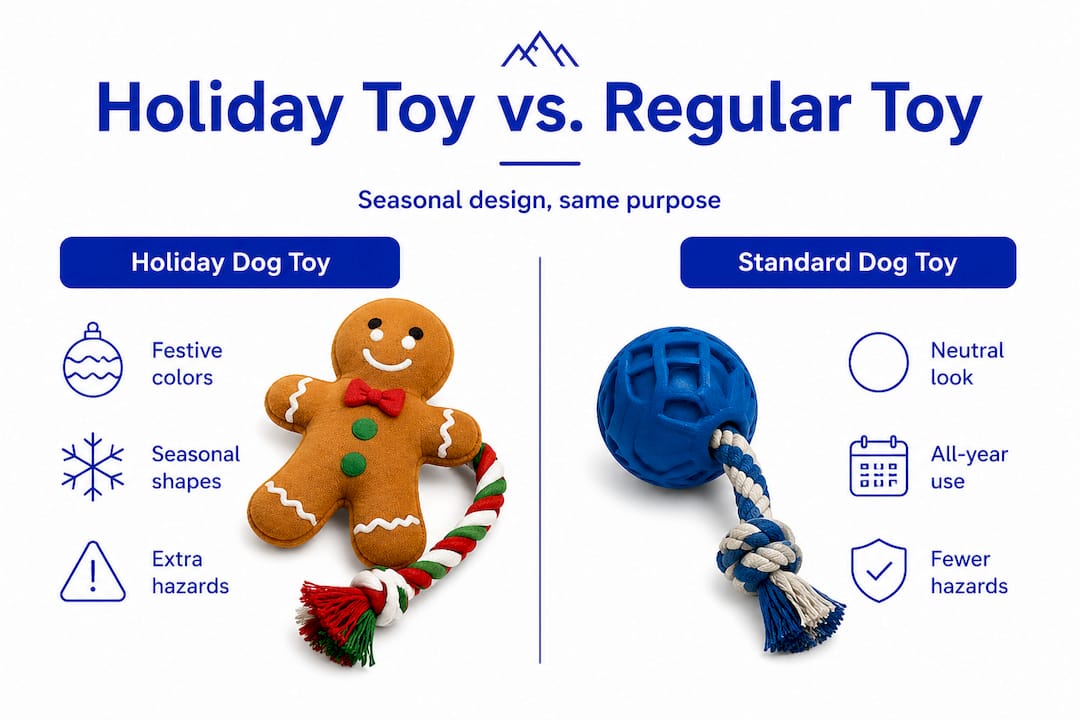
Holiday-themed toys carry the same risks as any dog toy, especially choking or foreign-body injury if the toy is the wrong size or gets torn into small pieces. The festive packaging does not change that reality. A toy shaped like a Christmas stocking is still a toy, and it still needs to meet the same safety standards as any other product you hand to your dog.
| Feature | Holiday dog toy | Standard dog toy |
|---|---|---|
| Design | Seasonal shapes and colors | Neutral or generic |
| Packaging | Gift-ready, bundled | Functional |
| Decorative elements | Ribbons, buttons, ornament details | Minimal |
| Core function | Chew, play, engage | Chew, play, engage |
| Safety requirements | Same as standard | Same as holiday |
The bottom line: holiday dog toys are standard toys with a festive coat. The fun is real. So are the risks.
Holiday hazards: Why safety matters more than ever
The holiday season creates a unique environment for dogs. Your home fills with decorations, guests, food, and distractions. That shift in routine and environment makes toy safety more important, not less.
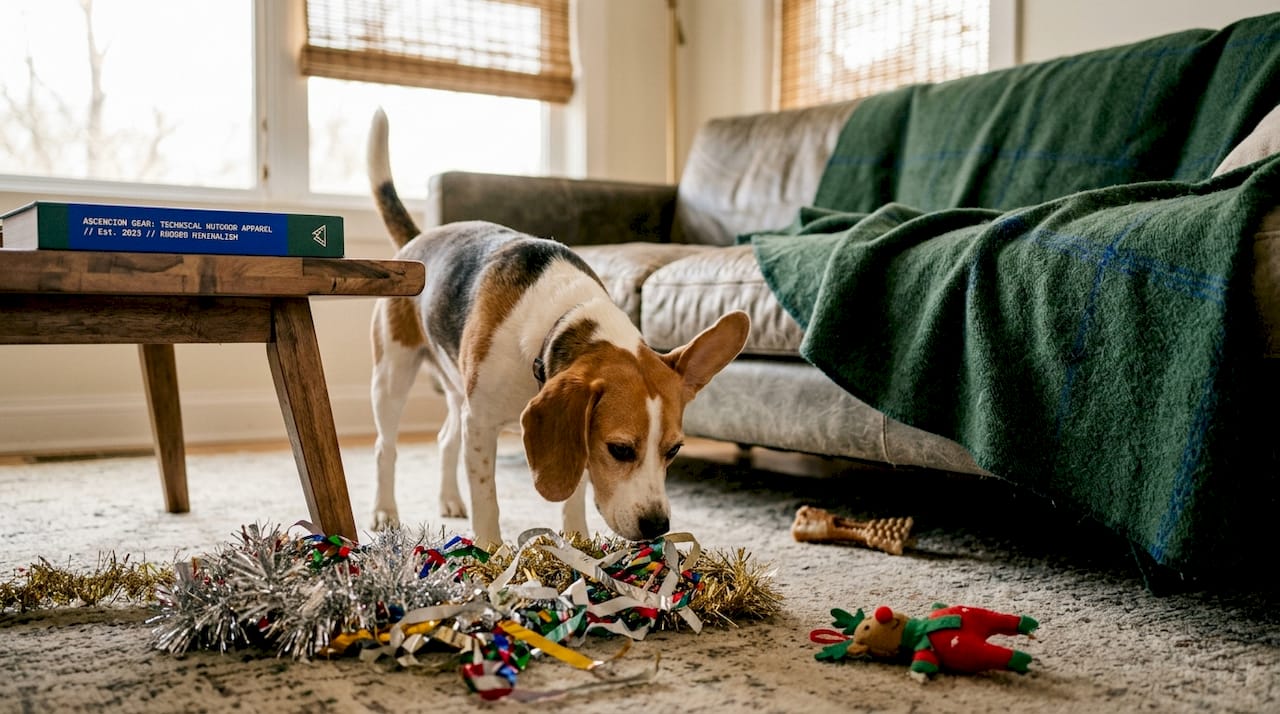
Festive settings introduce hazards that have nothing to do with the toy itself. Tinsel and ribbon are extremely dangerous if swallowed. Holiday plants like poinsettias, holly, and mistletoe are toxic to dogs. Electrical cords from light displays become chew targets. Wrapping paper, twist ties, and packaging foam end up on the floor during gift opening. Your dog is surrounded by potential hazards on all sides.
Holiday environments add serious ingestion risks beyond the toy itself, including tinsel, ribbon, string, toxic plants, and cords. Even a perfectly safe toy can become a problem when a dog is overstimulated by guests, noise, and new smells, and then left alone with it in a chaotic room.
Key holiday hazards to watch for:
- Tinsel and ribbon (linear foreign bodies that can cause intestinal damage)
- Toxic holiday plants (poinsettia, holly, mistletoe, amaryllis)
- Electrical cords and light strings
- Small ornaments and glass decorations
- Wrapping paper, tape, and packaging materials
- Food left out at parties (chocolate, grapes, xylitol)
- Candles and open flames within reach
“The holiday season consistently brings a spike in emergency vet visits tied to ingestion of foreign objects and toxic materials. Supervision is the single most effective prevention tool available to pet owners.” (DVM360, Holiday Hazards for Pets)
Squeaky nylon and rubber toys are a safer choice in busy holiday environments because they hold up better under stress and have fewer small parts to detach. For dogs who love the crinkle sound, crunchy plush toys with minimal decorative attachments are a good middle ground.
Pro Tip: Before any holiday gathering, do a sweep of the room your dog will be in. Remove all ribbon, tinsel, small ornaments, and any food within reach. Treat it the same way you would baby-proofing a space.
Choosing the right holiday dog toy for your pet
Picking the right toy comes down to knowing your dog. Size, age, chewing style, and energy level all matter. A toy that is perfect for a calm Cavalier King Charles Spaniel could be destroyed in under five minutes by a German Shepherd with a strong jaw.
Step-by-step guide to choosing a holiday dog toy:
- Measure your dog’s mouth. The toy should be too large to fit fully inside your dog’s mouth. If there is any doubt, go bigger.
- Assess your dog’s chewing style. Light chewers can handle plush and rope toys. Moderate chewers do well with rubber. Aggressive chewers need nylon or heavy-duty rubber.
- Check for detachable parts. Buttons, sewn-on decorations, plastic eyes, and ribbon ties should all be removed or avoided entirely.
- Read the label for size recommendations. Most reputable toy brands list recommended dog sizes. Follow them.
- Inspect the toy before giving it. Look for loose seams, weak stitching, and any parts that feel like they could pull free easily.
- Set a play schedule. Introduce new toys during supervised sessions, especially around the holidays when your dog may already be excited.
No toy is truly indestructible, and persistent chewers can work through even tough materials given enough time. That is why supervision and regular inspection are non-negotiable, regardless of what the packaging claims.
| Material | Durability | Best for | Caution |
|---|---|---|---|
| Rubber | High | Moderate to aggressive chewers | Check for cracking over time |
| Nylon | Very high | Aggressive chewers | Monitor for sharp edges as it wears |
| Plush | Low to medium | Light chewers, puppies | Remove when stuffing shows |
| Rope | Medium | Light to moderate chewers | Strings can be swallowed if frayed |
| Latex | Low to medium | Light chewers | Can tear quickly under pressure |
For dogs who chew hard and often, an indestructible nylon dog bone is a reliable option that holds up far better than plush holiday figures. If you want to give two options at once, durable nylon chew toys in a two-pack give your dog variety while keeping the material consistent. For dogs who love squeaky toys but chew through everything, a squeaky durable bear toy built for heavy chewers combines the fun of a squeak with materials that actually last.
Pro Tip: When giving a holiday toy as a gift, include a small card noting the dog’s size and recommending that the recipient check the toy’s size rating before giving it to their pet. It is a simple step that prevents a lot of problems.
Holiday fun without regrets: Best practices for safe play
Choosing the right toy is step one. How you manage playtime is step two. Both matter equally.
Toys should not be small enough to swallow or fit fully in the mouth. Toys with squeakers or small internal parts can become ingestion hazards if torn, and owners should inspect and remove damaged toys immediately. That rule applies every single day, but it becomes especially important during the holidays when play sessions may be longer, more frequent, and less supervised.
Top safety tips for holiday play:
- Always supervise your dog with a new toy for the first several sessions
- Remove the toy at the first sign of tearing, missing parts, or exposed stuffing
- Do not leave holiday toys out overnight or when you leave the house
- Rotate toys to keep your dog engaged without over-relying on one toy
- Keep holiday toys stored away from other decorations and hazards
- Check the toy after every play session, not just when something looks wrong
- For puppies, choose toys labeled for their specific size and age group
- When gifting a holiday toy, include care instructions and a note about supervision
New puppy owners face a specific challenge here. Puppies chew everything, and their jaws are strong relative to their size. A toy that seems large enough for a puppy can become a hazard quickly once it starts to break down. The durable holiday bear dog toy is a solid option for owners who want a festive look without sacrificing structural integrity.
Gift buyers should also think about this from the recipient’s perspective. A holiday toy given as a gift is a toy the recipient’s dog will interact with. Including a note about size guidelines and supervision is not overstepping. It is genuinely helpful.
Our take: Why the cutest dog toys aren’t always the safest holiday gifts
Here is something we see every year: dog owners come back after the holidays with stories about toys that fell apart in under an hour, squeakers that got swallowed, or plush figures that left stuffing all over the floor. And in almost every case, the toy that caused the problem was the one that looked the most festive.
The pattern is consistent. A toy shaped like a reindeer with a red velvet nose and jingle bell collar gets picked because it looks adorable in photos. But the jingle bell is a choking hazard. The velvet tears easily. The stuffing inside is not designed for a dog that chews with real force. The toy was built to look good on a shelf, not to survive a dog.
This is not a criticism of holiday toys as a category. It is a reminder that design and safety are two separate things, and they do not always overlap. The most beloved toys in any dog’s collection tend to be the ones that last. A beef flavored nylon bone is not going to win any beauty contests, but it will still be in one piece three months from now. That matters more than the packaging.
Our honest advice: buy the festive toy if you want to, but pair it with something durable. Let the holiday plushie be the fun, supervised treat. Let the nylon chew be the everyday option. That combination gives your dog variety without putting them at risk. And when you are buying a holiday toy as a gift, prioritize material quality over visual design. The recipient will thank you when their dog is still playing with it in January.
Find the perfect holiday toy and keep your pet safe
Ready to find festive toys that are both fun and safe? Ascencion Gear carries a range of durable, holiday-appropriate options for every dog type, from light chewers to the most aggressive destroyers.

Start with the no stuffing squeaky crinkle toy if you want a plush option that removes the stuffing hazard entirely. For dogs who love interactive play, the interactive octopus puzzle set gives you four pieces in one bundle, perfect for gifting or keeping your dog busy during holiday gatherings. All options ship across the US and are selected with durability and safety in mind.
Frequently asked questions
Are holiday dog toys safe for puppies?
Holiday dog toys can be safe for puppies if you select the right size, avoid toys with small parts, and supervise play at all times. Toys with squeakers or small parts can become ingestion hazards if torn, so inspect them frequently.
What materials are best for holiday dog toys?
Tough rubber and nylon are the best materials for holiday dog toys because they are durable and less likely to break into hazardous pieces. Reviewers and experts consistently recommend tougher materials paired with active supervision for the safest play experience.
Can I leave my dog alone with a holiday toy?
No, it is safest to supervise your dog when playing with any holiday toy to prevent choking or ingestion accidents. Holiday-themed toys carry the same risks as standard toys, including choking or foreign-body injury if the toy is the wrong size or gets damaged.
What should I do if my dog damages a holiday toy?
Remove the damaged toy immediately to prevent your dog from swallowing any small pieces. Owners should inspect and remove damaged toys as soon as tearing, missing parts, or exposed stuffing appears, regardless of how recently the toy was purchased.